AoIR is happy to announce the fourth roundtable in our lecture series:
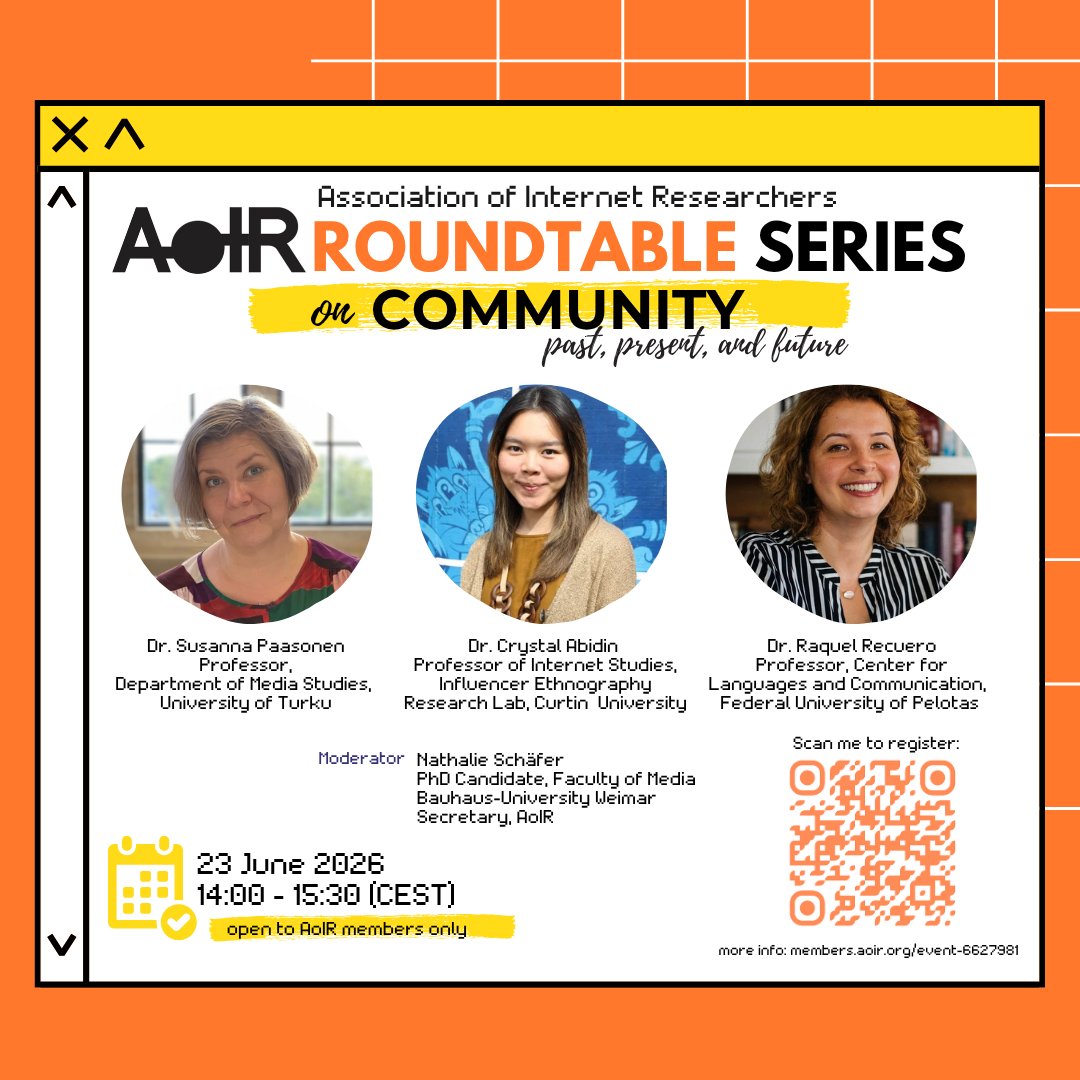
Community in Internet Research: Past, Present, Future When: 23 June 2026 @ 14:00 – 15:30 (CET) Location: Zoom – Link provided upon registration.
We bring together AoIR members Susanna Paasonen, Crystal Abidin, and Raquel Recuero for a roundtable on AoIR as a community — how it has formed, fractured, and functioned across nearly three decades of internet research.
The session asks what “community” has actually meant inside AoIR: who has been included, on what terms, and at what cost. The speakers will draw on AoIR’s history to examine alliance-building among critical researchers, the shifting platforms through which academic communities have tried to sustain themselves, and the structural inequalities that persist even as the organization has grown.
The lecture will be 45 minutes long with 45 minutes of Q&A and discussion with the audience.
More about our speakers and what they’ll be speaking about below!
Dr. Susanna Paasonen, Department of Media Studies, University of Turku, Finland
In AoIR’s early years, feminist, queer, and postcolonial researchers shared informal “birds of a feather” lunches at annual conferences — one table was roughly the right size. Today those same researchers would fill several rooms, and their diverging theoretical and political commitments would pull them into different ones. Paasonen’s talk takes that development as its starting point, focusing on the position of critical sexuality studies within AoIR and asking what alliances meant when the field was small, what they mean now that it isn’t, and what gets lost when a community grows too large for the formations that once held it together.
Dr. Crystal Abidin, Influencer Ethnography Research Lab, Curtin University, Australia
AoIR members have studied online communities for nearly 30 years while also trying to build one. Across bulletin boards, listservs, Facebook, Twitter/X, Mastodon, and Bluesky, scholars have negotiated visibility and opinion leadership differently each time — responding to platform norms, job market pressures, and shifting ideas about what public intellectualism looks like. Abidin’s contribution tracks how academic communities have formed and re-formed through those platform transitions, who has emerged as a voice in each iteration, and who has been left behind.
Dr. Raquel Recuero, Center for Languages and Communication, Federal University of Pelotas, Brazil
AoIR has functioned as more than a professional association — it has been a space through which internet researchers recognize the field and one another. But that space has never been neutral. Asymmetries between the Global North and South, linguistic barriers, and uneven conditions of participation have run through its history. Recuero’s talk draws on that history to argue that “community” should not be treated as something AoIR already has, but as something that requires active construction — especially now, when global fragmentation makes mutual intelligibility harder to sustain.