
Each year a small portion of AoIR conference fees go toward several Kelly Quinn Travel Scholarships for junior scholars to attend the conference. We want to recognize our scholarship recipients and share with you a little bit about them and their research interests.
Who are you?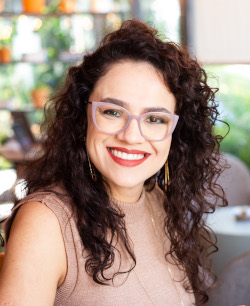
I am Raquel Pereira Rodrigues Leite, a 36-year-old Brazilian journalist, Assistant Professor at the Pontifical Catholic University of Paraná (PUCPR). I hold an MA in Communication (2022) and I am currently a PhD candidate in Communication at the Federal University of Paraná (UFPR). My master’s dissertation, defended in 2022, investigated misogyny and hate speech in open WhatsApp groups, a project that received the program’s Academic Excellence Award that year. Since 2020, I have been a member of the InfoMedia – Information Media Lab, collaborating on research on platformization, digital vulnerabilities, governance, moderation, and regulation.
Where are you from?
I am from Curitiba, Paraná, Brazil.
What is your current area of study?
Since my master’s, my main interest has been in studying platformization and digital vulnerabilities. I am currently a PhD candidate in Communication, which I expect to defend by March 2028. In my thesis, I investigate how Meta Platforms Inc. (Facebook, Instagram, WhatsApp, and Threads) consolidates itself as a disciplinary institution in the Latin American digital panopticon. My research examines tangible and intangible control mechanisms — terms of service, affordances, official discourses, infrastructure, moderation mechanisms, as well as practices such as disinformation and hate speech — to understand how these elements contribute to shaping new forms of surveillance and disciplinary power in the digital environment, drawing on Foucault and Han. I also conduct research on platform governance, terms of use, moderation, and control mechanisms across different platforms, with a particular focus on gender-based violence.
Describe the research you will present at AoIR2025.
I will present, with my co-advisor, Professor Dr. Luiza Carolina dos Santos, the article “Platform Governance on Violence Against Women: Analysis of the Community Guidelines of Instagram, YouTube, TikTok, and Twitch.” The study analyzes how these four platforms address violence against women in their Terms of Service and Community Guidelines. The research examines practices such as stalking, doxxing, leaking intimate images, hate speech, harassment, disinformation, and political gender-based violence. Preliminary results indicate that, although gender is mentioned in sections related to hate speech, none of the platforms have specific policies to address violence against women. In many cases, the responsibility is shifted to the participants themselves, with limited resources for protection. The study’s contribution is to highlight gaps in digital platform governance, emphasizing that online gender-based violence should not be seen solely as an individual women’s problem, but as a democratic and human rights issue.
Have you presented at AoIR in the past? If so, what was your experience? If #AoIR2025 in Niterói is your first AoIR conference, what made you choose this conference? What do you expect from it?
This will be my first time participating in AoIR. The conference was suggested by my co-advisor, who recognized it as the ideal space to deepen the international debate on platform governance and digital regulation from a critical and interdisciplinary perspective. I hope to engage with academics from different countries, strengthen academic collaboration networks, and share the preliminary results of the research projects I’m involved in. I was delighted to receive the Kelly Quinn Travel Grant, which enabled me to participate in person. I consider AoIR 2025 a unique opportunity for internationalization, visibility, and academic exchange, especially considering the international scope of the conference and the high-quality debates.