
The AoIR Nancy Baym Annual Book Award committee is happy to announce the winner of this year’s award. We received nearly 30 nominations for 2026 and the decision was not an easy one. The winner of the 2026 Nancy Baym Book Award is…..
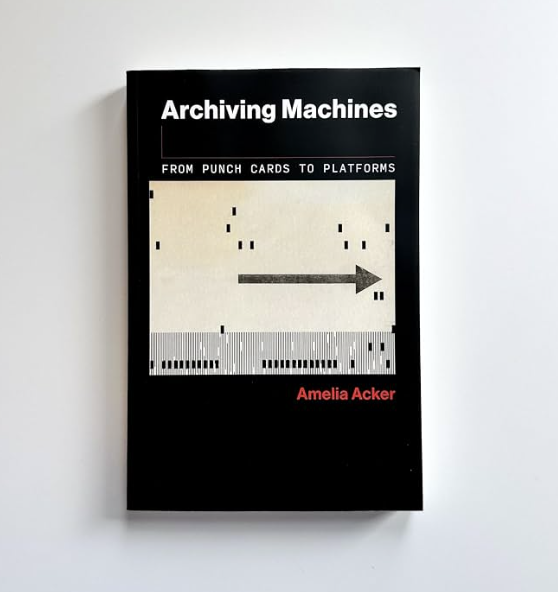
Archiving Machines: From Punch Cards to Platforms
By Dr. Amelica Acker
This historically grounded monograph offers a compelling account of the transformation of data archives—from pre-digital collections to privately owned, cloud-first infrastructures increasingly accessed through mobile applications—with a particular focus on archival power. Drawing on original archival and historical research, Acker connects the etymology and history of the archive to contemporary practices of data collection, storage, networking, and access. Through its focus on “archival power,” Archiving Machines brings media history, infrastructure studies, archival studies, and critical data studies into productive conversation. This historical and conceptual approach illuminates how infrastructures can disempower both the public and institutions by limiting their access to the information they create. Acker’s rich analytical schema therefore not only explains the transformation of archival power, but also clarifies the choices confronting society as technology continues to evolve. In this way, the monograph provides a valuable bridge between the history of data and our emerging data and AI future.
And announcing our runner up:
Healthy Users: The Governance of Social Media Well-being
By Dr. Niall Docherty
This timely and conceptually incisive book challenges the assumption that social media well-being can be secured through individual “healthy” choices concerning screen time, mindfulness, and self-discipline. By demonstrating how this discourse of personal responsibility obscures the structural conditions of platform capitalism, Healthy Users shifts attention from individual behavior to the interfaces, commercial interests, institutional power, and cultural norms that shape peoples lived experiences of social media. It situates this individualization of responsibility within longer critical debates about responsibilities, self-management, and moral regulation, providing a rich theoretical framework for understanding contemporary digital well-being discourse. This intervention is especially pertinent amid growing political concern about social media addiction and harm, proposals for legal age restrictions, and the expanding role of technology in healthcare. Although critical platform studies and digital well-being research have previously recognized the individualization of responsibility, Healthy Users brings these insights together into a distinctive account of how the “healthy user” is constructed and governed. In doing so, the monograph reveals the broader systems of power and value that make such solutions appear both necessary and natural.
Please join us in sharing a big congratulations to Dr. Acker and Dr. Docherty.
About This Year’s Committee and Selection Process
We extend a huge thank you to this year’s committee for all their work over the last few months. The international committee was comprised of Drs. Jun Liu (Chair), Nancy Baym, Giota Alevizou, Marco Bastos, JG McNutt, and Gina Sipley. The committee followed a two-stage process. In Stage One, members were divided into two review groups. Each group reviewed its assigned slate of books and selected the top three for further consideration. In Stage Two, all committee members read the six shortlisted books and determined the final ranking to select the winner and runner-up. Committee members evaluated submissions based on scholarly quality, conceptual innovation, and contribution to internet research and the AoIR community.